Humic acid fertilizer and potassium humate in fertigation: a compatibility checklist

Before using a liquid humic acid fertilizer or potassium humate in fertigation, confirm that the instructions for the exact product permit injection into your irrigation system. Review the water analysis and check the injector, filters and emitters against the equipment manuals. If physical compatibility is uncertain, ask an adviser whether the instructions allow a small-scale jar test.
Check the product, water and equipment
If a supplier offers potassium humate, ask for the specification identifying that form and the instructions covering fertigation. When comparing humic or fulvic acid content across offers, check the measured fraction, method, unit and reporting basis. How to read a fertilizer analysis
Record the water source and sample date for the block where you plan to inject. If the block receives a blend of well and reservoir water, check whether the tested sample represents that blend. Keep the current labels and instructions for each product beside the water report.
| Input to check | Why it matters | Report or instruction to consult |
|---|---|---|
| Exact product and other inputs planned for injection | The product instructions define permitted application methods and may specify water, equipment or mixing restrictions. | Current label and application instructions for each product |
| pH, unitless | Describes how acidic or basic the water is at measurement. It helps assess conditions in which precipitates may form. | Irrigation water analysis |
| Alkalinity, commonly mg/L as CaCO₃ | Describes the water's capacity to neutralise acid, often associated with bicarbonate and carbonate. | Irrigation water analysis |
| Hardness, commonly mg/L as CaCO₃ | Reflects mainly dissolved calcium and magnesium. These ions may participate in precipitation under some conditions. | Irrigation water analysis, including calcium and magnesium where reported |
| Electrical conductivity (EC), commonly dS/m or mS/cm | Indicates the overall level of dissolved ions. Use the individual results to identify which ions are present. | Irrigation water analysis, with the unit and reference temperature where reported |
| Filter, injector and emitters | Filtration addresses particles, while precipitation can form after inputs meet. The injection point helps identify which equipment and lines are exposed. | System diagram and equipment manuals, including filter rating in µm where specified |
Read each water measurement separately. Record the filter type and rating as fitted, including recent changes. If the system has a history of deposits or uneven emitter flow, include the affected block and dates when asking for advice.
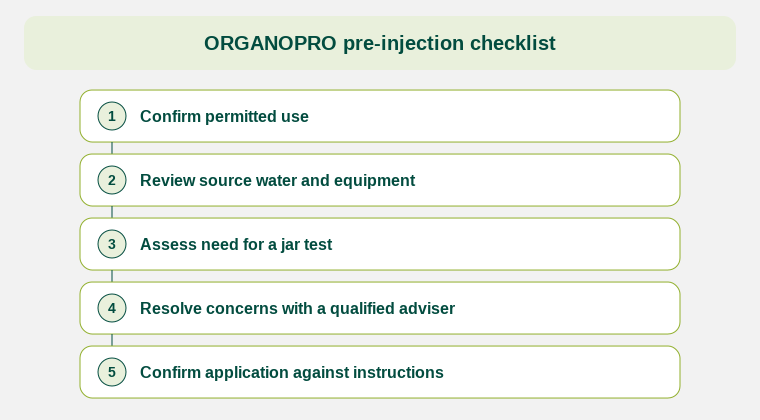
ORGANOPRO pre-injection checklist. Confirm permitted use, review source water and equipment, assess the need for a jar test and resolve concerns before injection.
Use a jar test to look for physical changes
A jar test is a small-scale observation of a specific combination of water and products. Use the actual source water and document the products and conditions being evaluated. Have a qualified adviser determine how to represent the intended application and when to inspect the sample within the product instructions. Record the source, date, water temperature and observation interval when relevant to the comparison.
Look for new cloudiness, flocs, visible precipitate, settling or separation. Record the initial appearance and what changes during the observation period. Some liquids have a strong colour, so describe new changes relative to the starting appearance. If the sample is difficult to interpret, set the result aside for review and resolve the uncertainty before injection. Where a visible change occurs, keep the observation with the water report and product instructions so an adviser can evaluate the combination.
A clear test indicates that you observed no visible physical change under the tested conditions and within the observation period. Crop safety, agronomic performance and permission for the intended use each require a separate check. If the source water or blend changes, review an updated analysis and reassess whether the earlier observation applies. Recheck equipment suitability when the filter, injector or emitters change.
FAQ
What should I check before ordering potassium humate for fertigation?
Confirm the product form in the specification and request instructions for the exact product. Check permitted application methods, water and filtration requirements, and restrictions for use with other products in the same system.
How do hardness and alkalinity differ?
Hardness mainly reflects dissolved calcium and magnesium. Alkalinity measures acid-neutralising capacity. Read both values, even if each is expressed as mg/L as CaCO₃.
Can we inject after a clear jar test?
Review the product instructions for the intended use and confirm that the water and equipment meet the applicable requirements. A clear jar test records the absence of visible changes in that sample during the observation period.
What should we check after changing filtration?
Record the new filter type, rating and location relative to the injector. Check them against the equipment and product instructions, then reassess the application with your adviser if the new configuration changes the conditions originally reviewed.
Request guidance for your irrigation system. Provide the intended product, water analysis, filter type and rating, and the injector and emitter models. If you are considering ORGANOPRO SUPREME, request the current instructions to confirm the permitted methods and applicable conditions.
Sources and scope
- Water quality, filtration, precipitation and physical observations during a jar test. UF/IFAS, How to Reduce Clogging Problems in Fertigation
- Use of source water for a small-scale physical compatibility check. Utah State University Extension, Fertigation Facts
- Definitions of alkalinity and hardness, and how to interpret pH and EC in a water report. UF/IFAS, Alkalinity and Hardness, UF/IFAS, Irrigation and Household Water Test and Interpretation
Andrey Nilov, CEO of ORGANOPRO. Personal LinkedIn

Let’s connect on LinkedIn
Let’s exchange ideas about current issues in agriculture, soil fertility and the challenges farmers face. I’d be delighted to connect and have an open conversation.
Warm regards, Andrey Nilov
CEO of ORGANOPRO
Connect with me on LinkedIn Connect with me on LinkedIn